
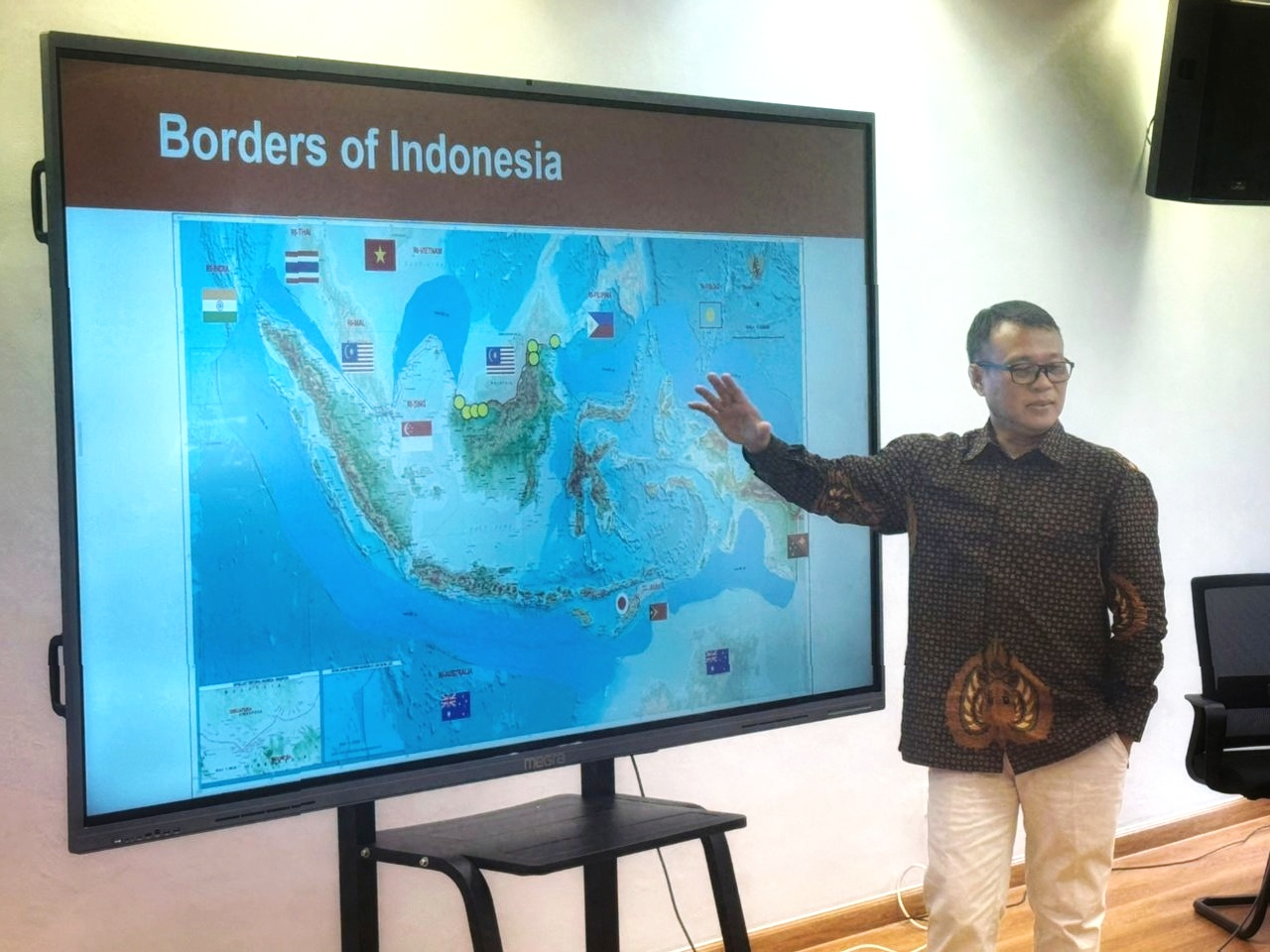
Kuala Lumpur, September 2, 2025 – Universiti Kebangsaan Malaysia (UKM), in collaboration with the Public Service Department of Malaysia (Jabatan Perkhidmatan Awam/JPA) and the National Security Council (Majlis Keselamatan Negara/MKN) Malaysia, organized the Executive Training on Border Management 2025.
In the morning session, Dr. Fauzan, Lecturer at the Department of International Relations, Universitas Pembangunan Nasional “Veteran” Yogyakarta (UPNVY), delivered a lecture titled “Managing Borders Today: Concepts, Limology (Border Studies), and Contemporary Debates.”
Dr. Fauzan highlighted that borders should no longer be understood merely as static lines on a map, but as dynamic living spaces shaped by conflict, security, diplomacy, mobility, and everyday community interactions. He introduced the concept of Limology, or border studies, as an evolving interdisciplinary field that combines geography, politics, sociology, law, and anthropology to better understand border realities.
His session emphasized that border management today involves balancing sovereignty and security with the needs of local communities and cross-border cooperation. Contemporary debates, such as security versus mobility, integration versus exclusion, and the rise of new non-physical borders (digital, health, environmental), were also discussed as critical challenges for policymakers.
In the afternoon, Dr. Fauzan joined a high-level panel discussion alongside Prof. Dewi Fortuna Anwar (National Research and Innovation Agency, BRIN, Indonesia) and Dr. Aizat Khairi (UKM). The panel explored ASEAN’s role in addressing border disputes and mechanisms for peaceful conflict resolution.
The discussion underscored that while borders often generate tensions, they also present opportunities for cooperation. ASEAN was recognized as an important platform in maintaining regional stability through dialogue, diplomacy, and constructive dispute settlement.
This event reaffirmed the need to view borders not merely as territorial divisions but as spaces to foster trust, solidarity, and a shared future in Southeast Asia.